Featuring new stories by Baba Ademoroti, Kyle Alderdice, Manuel Gonzales, Nic Guo, Simon Han, Ammi Keller, and Mathilde Merouani.
 Baba Ademoroti, “Intimacy”
If Bade chilled, took one two three seconds to look, he’d see that no part of that day made brain. First, he slept through his alarm, which meant he missed his carpool. Then his Uber driver, a man who was all teeth and forehead, lacked the vim necessary to ply Lagos traffic. Of course the AC was faulty, and with the windows down (Oga, I hope you don’t mind) they slugged from Surulere through Eko Bridge to Victoria Island, danfo fumes choking and trailer horns grating; two hours, for a journey that would have taken thirty minutes had he woken thirty minutes earlier. Pim, Bade didn’t say, his arms folded as the man jabbered on.
—
News traveled quickly in the days we were stationed in Rouen, and word of her military successes and her spiritual calling preceded her by many months; it was as if horses ran faster, and people wrote and spoke more clearly then, aided somehow from above. I believed in such heavenly intervention then, and I still do now. It was our biggest difference, Frémin and I, for Frem was the rare soldier who didn’t believe in God; it was clear he too fought for love, for life, for land, but never for the divine.
—
I first met Lucy Harrison at an artist residency fifteen years ago, when I still fashioned myself a poet, and, suffering from a newly broken heart, spent most of my month there memorizing the saddest poems I could bring myself to find in the residency’s extensive collection of very sad poems. Ultimately, this had the effect of convincing me I would never be quite a great poet, and by the time I left behind the New England mansion, I had also left behind poetry, or writing it, anyway. Lucy Harrison arrived at the mansion halfway through my own stay and immediately set herself apart, first, by bringing with her a full-sized suitcase entirely full of liquor bottles—gin, tequila, bourbon and rye, mostly—and second, by acting squirrelly and suspicious about the art she was there to engage in, offering a different answer each time she was asked. She told me she was there as a sculptor, then a few days later, a writer, and finally a performance artist. Another resident had been told she was an acrobat, another a clown who specialized in fire-eating, and someone else thought Lucy was a filmmaker. No one knew what to make of her, but ultimately we didn’t really care because she was a laugh, she liberally shared her booze, and she liked to dance.
—
Some lady had tried to bring a live chicken on the bus, which caused a bit of a stir. The snow pelted down and we felt badly for her. She was all alone, without husband or child to help. Already her dark silhouette was dotted white. If no one came to her aid, the snow threatened to disappear her entirely. In the folds of her coat, the chicken flapped madly, scattering snow, unable to wrest free of her woolen arm. It was a little crazy. The bus driver must’ve thought so too, because he had left his plastic compartment and stood blocking the doorway. I was sitting up front and got a good look at the lady and her chicken. She was short and appeared to be in her mid-fifties. The bird was black with red features. Seeing the commotion, a crowd of people moved to board through the back instead.
—
Tomorrow is our birthday. We spend the evening on my brother’s phone, reminding our parents about our earlier birthdays. They WeChat us from their apartment in Beijing, a light-filled structure of imitation marble, with a housemaid clattering about in their kitchen. Tell your mother about the first one, our father says. The first one after we moved to the States, we assume—oh College Station and your grasshoppers and Cracker Barrels and inflatable pools sagging on your front lawns. “Tell her about the cakes she spent all morning making,” he says.
—
She’d been an ungainly, ostracized ten-year-old, but by her early thirties, Nine had ripened into a chiseled, radical artist. Then the pandemic hit and she reverted to the mean.
This was how she felt at forty-two in Oakland, California. Even her facial features seemed fatter and flatter, as though a truck convoy had
passed over her while she lay on her back staring at the moon.
—
When Lyle Arnolds is seven, his parents drive to pick up Sara, who is eight—they are going to the state fair in Des Moines, Iowa. It is summer, and the sun hurts. The month has been full of storms. Lyle doesn’t know this will be his last anchored memory of Sara Morales as a young child. A year later, she will move to Kansas. Other memories float: he and Sara chase shadows along the Iowa River, unless it is Lake MacBride; it is March or it is April. That afternoon at the fair is certain. It is 1999, it is August, and Sara’s hair is loosely braided.
—
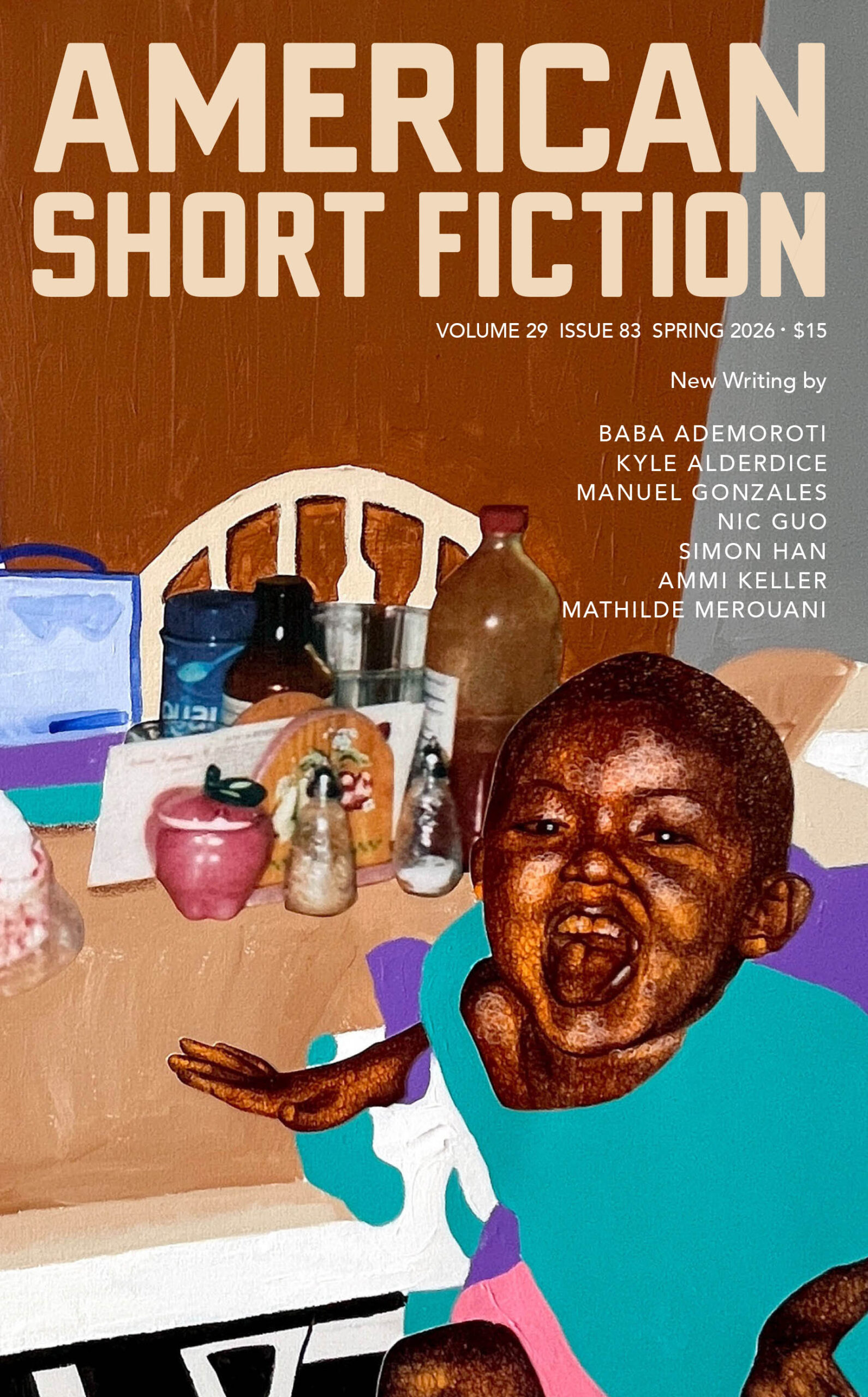
ASF Issue 83 Cover Art by Adrian Armstrong.
—